
Hand-painted Jingdezhen Master Cup: The Silent Whisper of Blue and White Porcelain
Hand-painted Jingdezhen Master Cup: The Silent Whisper of Blue and White Porcelain
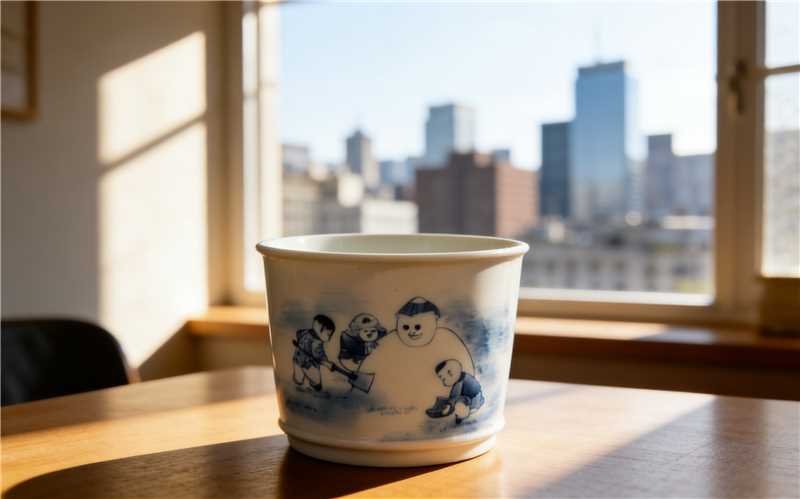
It was a Tuesday afternoon, the kind where the light slants through the window just right, catching the dust motes and turning them into gold. I was sitting at my desk, the city outside humming its usual indifferent drone, when I reached for my tea cup. Not just any cup, but a hand-painted Jingdezhen master cup, a small, unassuming vessel of blue and white porcelain, resting on a wooden coaster that had seen better days. As my fingers wrapped around its curve, I didn’t just feel the coolness of the ceramic; I felt a connection. A connection to the hands that shaped it, the brush that drew it, and the centuries of tradition that flowed through it.
This is the story of that cup. A Blue and White Porcelain Master Cup, born in the kilns of Jingdezhen, China, and brought to life by the steady hand of an artisan who poured their soul into every stroke.
The Weight of Jingdezhen: Birthplace of the Master Cup
To understand this Hand-painted Jingdezhen Master Cup, one must first understand its birthplace.
Jingdezhen. The name itself sounds like a melody, a whisper from the past. For over a thousand years, this city in Jiangxi province has been the undisputed capital of porcelain. It is where the earth yields the finest kaolin clay, white as snow and pure as a newborn’s promise. It is where the fire of the kiln transforms the soft, malleable clay into a substance harder than stone, yet delicate as a butterfly’s wing.
When I hold this cup, I am holding a piece of that history. The clay was likely dug from the hills surrounding the city, washed, refined, and kneaded by hand until it achieved the perfect consistency. It was then thrown onto a potter’s wheel, spinning and rising under the potter’s palms, forming the shape of a master cup—small, personal, designed for savoring a single infusion of tea, not for gulping down a morning caffeine fix. This is a vessel for contemplation.
The Dance of the Brush: Hand-painted Artistry
But what truly sets this blue and white porcelain apart, what makes it more than just a container, is the painting. The description says “hand-painted,” but those two words barely scratch the surface of the reality. To see it is one thing; to understand the process is another.
I once visited a small studio in Jingdezhen, tucked away in a narrow alley behind the main market. The air was thick with the smell of wet clay and the sharp, metallic scent of cobalt oxide. An elderly master sat at a low table, his back slightly stooped, his eyes focused intently on a piece of porcelain resting on a rotating stand. In his hand, he held a brush with a tip finer than a cat’s whisker.
He was painting a scene. Not a generic floral pattern, but a specific, narrative image. On the cup in my photo, the scene is one of winter joy. A large, round snowman stands in the center, its face simple and smiling. Around it, three children are engaged in the act of building. One, wearing a hat, leans into a shovel, pushing snow. Another, bundled up in a coat, watches with a grin. The third, smaller child, sits on the ground, perhaps having fallen in the snow, but laughing all the same.
To paint this on a curved, three-dimensional surface requires a skill that defies logic. The artist must visualize the entire scene, then translate it onto the porcelain master cup, adjusting the perspective as the cup rotates. The lines must be confident. A hesitant stroke is visible forever. The cobalt pigment, mixed with a secret recipe of oils and water, must be applied with just the right amount of pressure. Too much, and the line bleeds; too little, and it vanishes in the firing.
The Fire Test: Creating Blue and White Porcelain
Once the painting is complete, the cup is not yet finished. It is fragile, the blue lines sitting on the surface like a memory. It must go into the kiln. This is the moment of truth. The kiln is heated to over 1,300 degrees Celsius. For hours, the cup bakes in the intense heat, the clay vitrifying, becoming translucent and strong. The cobalt oxide, under the heat and the glaze, undergoes a chemical alchemy. It melts, sinking into the glaze, and emerges not as a painted line, but as a part of the porcelain itself. The blue deepens, becoming a rich, lustrous cobalt, often described as “blue like the sky after rain.”
When the kiln cools, the master opens the door. It is a moment of high tension. Sometimes, a cup cracks. Sometimes, the glaze runs. Sometimes, the fire takes a piece of the artist’s soul and leaves a flaw. But when it works, when the hand-painted Jingdezhen cup emerges perfect, it is a triumph. The image of the children and the snowman is no longer just a drawing; it is a captured moment, frozen in time and ceramic.
The Ritual of Tea with a Jingdezhen Master Cup
So, why do we use such a cup? Why spend the time, the money, the effort on a small piece of hand-painted porcelain when a glass or a plastic mug will do?
It is about the ritual. In the modern world, we are surrounded by mass-produced objects. They are efficient, cheap, and disposable. They ask nothing of us and give nothing back. A hand-painted Jingdezhen master cup is the antithesis of that. It demands attention.
When I brew tea in this cup, I am not just making a drink. I am participating in a ceremony. I warm the cup with hot water, feeling the heat transfer through the thin walls. I add the leaves—perhaps a Tie Guan Yin, its leaves unfurling like tiny green flowers. I pour the water, watching the steam rise, smelling the aroma bloom.
And then, I pour the tea into the cup. The amber liquid contrasts beautifully with the white porcelain and the blue painting. As I lift the cup to my lips, my fingers trace the rim, feeling the slight imperfection of the hand-thrown shape. I take a sip. The tea is hot, fragrant, complex.
But more than the taste, I am tasting the story. I am tasting the kaolin from Jingdezhen, the cobalt from the earth, the fire of the kiln, and the patience of the artist. I am tasting a moment of winter, of children playing in the snow, a scene of pure, simple joy that has been preserved for me to see every time I drink.
A Legacy in Your Hands
In a way, owning a hand-painted Blue and White Porcelain Master Cup is like being a curator of a tiny museum. You are the temporary guardian of a piece of art. You will use it, perhaps daily, perhaps only on special occasions. You will wash it carefully, dry it with a soft cloth, and place it back on its shelf.
And when you do, you are not just putting away a cup. You are closing a chapter of a story that began centuries ago in a Chinese kiln and continues today in your own home. It is a reminder that beauty exists in the details, in the handmade, in the things that take time. It is a whisper against the noise of the modern world, saying, “Slow down. Look closer. Savor the moment.”
That is the magic of the cup. It is not just porcelain and paint. It is a vessel for memory, for art, and for the quiet joy of a well-lived life.

Add comment