
7 Reasons Why This Blue and White with Underglaze Red Lid Rest Will Transform Your Tea Ceremony Forever
In the quiet corner of a sunlit tea room, where the scent of aged pu-erh mingles with the soft rustle of silk robes, there sits a small object that often goes unnoticed by the casual observer. It is not the teapot, the star of the ceremony, nor the delicate teacups that cradle the amber liquid.
It is the Blue and White with Underglaze Red Lid Rest—the humble, silent guardian that holds the steaming lid of the gaiwan, protecting the table from water rings and the lid from chipping.
Why the Blue and White with Underglaze Red Lid Rest Is More Than Just a Tea Accessory
I am Wang Shaowei, a tea lover and collector from Jiangxi, where the kilns of Jingdezhen have been firing porcelain for a thousand years. I have spent decades chasing the perfect teapot, the rarest oolong, the most delicate porcelain.
But it was not until I held a small, hand-painted Blue and White with Underglaze Red Lid Rest in my hands that I understood the true soul of tea ware.
This is not just a functional object. It is a story.
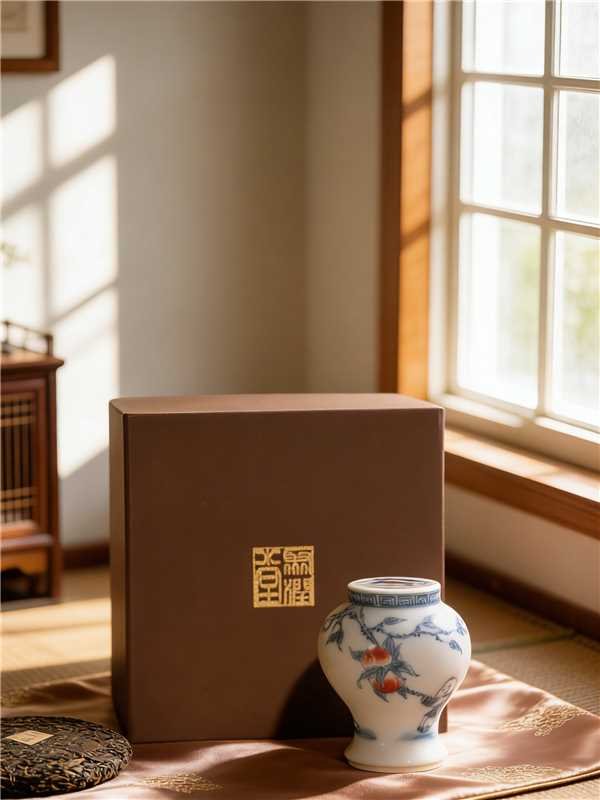
The Day I Met the Blue and White with Underglaze Red Lid Rest with Child and Peach Motif
It was a cool autumn morning in 2018. I was browsing a small antique shop in the old quarter of Jingdezhen, the air thick with the smell of wet clay and wood smoke.
The shopkeeper, an old man with hands stained with cobalt blue, was sorting through a box of broken shards and forgotten pieces. Among them, I saw a small, 葫芦-shaped object, no bigger than my palm.
It was a Blue and White with Underglaze Red Lid Rest, but unlike any I had seen before.
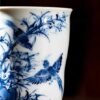
The body was pure white porcelain, smooth as a baby’s skin. Around the neck, a band of blue geometric patterns framed the top.
But the real magic was on the side: a playful child, painted in cobalt blue, reaching up toward a branch of peach blossoms.
The peaches were painted in underglaze red—a rare and difficult technique where the red pigment must be fired at exactly the right temperature, or it turns black or gray.
These peaches were a deep, vibrant red, like ripe fruit in the summer sun.
“This is a Julantang ‘Welcoming Longevity’ Blue and White with Underglaze Red Lid Rest,” the old man said, seeing my interest. “Hand-painted by Master Li, who passed away last year. He only made a few of these.”
I bought it on the spot. I didn’t know then that this small object would become the centerpiece of my tea table, and the inspiration for this article.
[Image suggestion: Add photo of the lid rest with alt text: “Blue and White with Underglaze Red Lid Rest featuring child and peach motif”]
The Art Behind the Blue and White with Underglaze Red Lid Rest Craftsmanship
To understand why this piece is so special, you have to understand the craft behind it.
The Porcelain Body of the Blue and White with Underglaze Red Lid Rest
The base is made from high-quality kaolin clay, sourced from the hills of Jingdezhen. It is fired at 1300°C, making it hard, durable, and resonant.
When you tap it, it sings—a clear, ringing tone that tells you it is good porcelain.
The Hand-Painted Design on the Blue and White with Underglaze Red Lid Rest
The design is not printed or stamped. It is hand-painted by a master artist, using a fine brush and cobalt blue pigment for the child and the branches, and underglaze red for the peaches.
The child is painted in a traditional “child and peach” motif, which symbolizes longevity and good fortune.
In Chinese culture, the peach is the fruit of the immortals, and the child represents the future and the continuation of the family line.
The Underglaze Red Technique in Blue and White with Underglaze Red Lid Rest
Underglaze red is one of the most difficult techniques in porcelain making. The red pigment is made from copper oxide, which is very sensitive to temperature and atmosphere in the kiln.
If the temperature is too high, the red turns black. If it is too low, it turns gray.
Only a master potter can control the kiln well enough to get that perfect, vibrant red.
[Learn more about Jingdezhen porcelain techniques]
5 Compelling Reasons Why This Blue and White with Underglaze Red Lid Rest Belongs on Your Tea Table
You might ask, “Why spend money on a lid rest? Can’t I just use a spoon or a chopstick rest?”
You can. But a tea ceremony is not just about drinking tea. It is about the experience—the ritual, the beauty, the connection to tradition.
When you use a Blue and White with Underglaze Red Lid Rest, you are not just holding a lid. You are holding a piece of art.
You are connecting with the master who painted it, the potter who shaped it, and the centuries of tradition that went into its creation.
Every time I use mine, I think of the old man in the shop, and Master Li, and the child reaching for the peach.
It reminds me that tea is not just a drink. It is a way of life.
[Check out our complete tea ceremony guide for more tips]
How to Use and Care for Your Blue and White with Underglaze Red Lid Rest
Using a lid rest is simple. When you are brewing tea in a gaiwan, you lift the lid to pour the tea.
Instead of placing the lid on the table, you place it on the Blue and White with Underglaze Red Lid Rest.
This keeps the table clean and the lid from chipping.
To care for your lid rest, simply wipe it with a soft cloth after use. Do not use soap or abrasive cleaners, as they can damage the glaze.
If it gets stained, you can soak it in warm water for a few minutes, then wipe it clean.
The Legacy of Julantang: Makers of the Finest Blue and White with Underglaze Red Lid Rest
Julantang is a brand that I have come to trust over the years. They are not a mass-production factory.
They are a studio of artists and potters who believe in the value of hand-made, traditional craftsmanship.
Their Blue and White with Underglaze Red Lid Rest is a perfect example of their philosophy.
It is not perfect in the way a machine-made object is perfect. It has slight variations in the brushstrokes, tiny imperfections that make it unique.
And that is what makes it beautiful.
[Image suggestion: Add photo of Julantang workshop with alt text: “Julantang artisans creating Blue and White with Underglaze Red Lid Rest”]
A Final Thought on the Blue and White with Underglaze Red Lid Rest
I have many tea wares in my collection. There are teapots from Yixing, cups from Dehua, and incense burners from Japan.
But the Blue and White with Underglaze Red Lid Rest from Julantang is the one I use every day.
It is the one that brings a smile to my face when I see the child reaching for the peach.
If you are looking for a gift for a tea lover, or a piece to add to your own collection, I highly recommend the Blue and White with Underglaze Red Lid Rest.
It is more than a tea accessory. It is a piece of art, a story, and a connection to tradition.
And who knows? Maybe one day, you will pass it on to your child, just as the old man in the shop passed it on to me.

Add comment